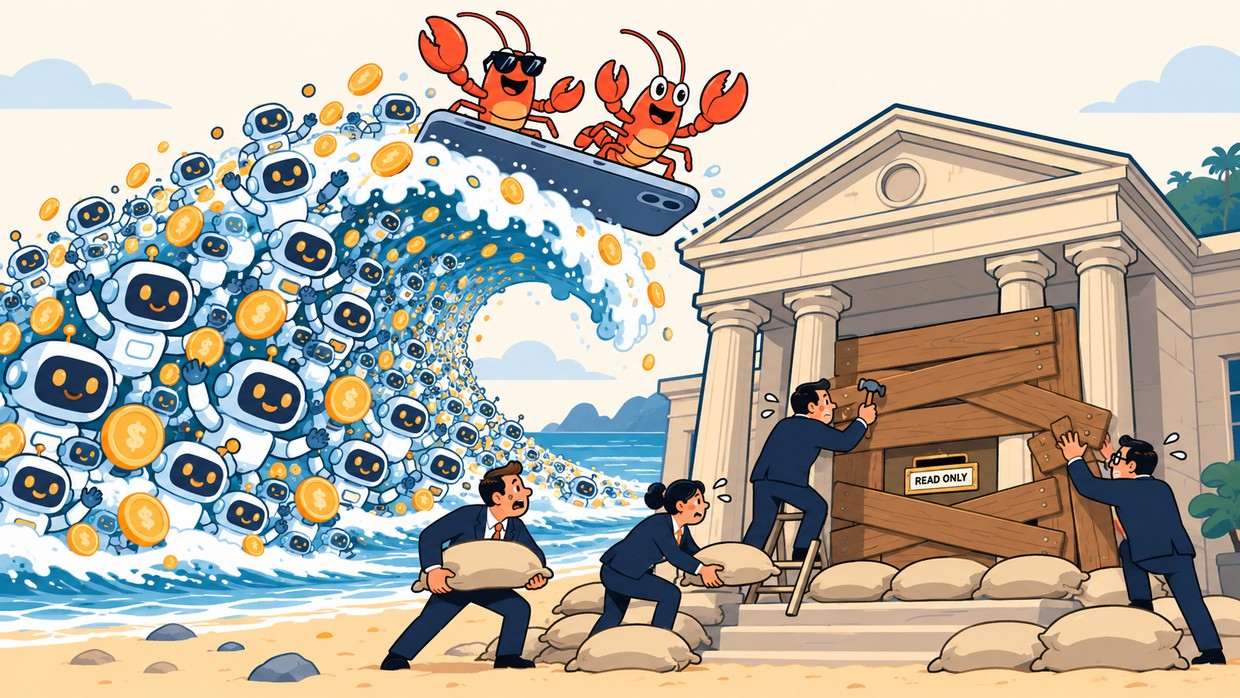
In October 2026, the largest banks in the United States started stacking sandbags at their doors. The water they expect is software.
The doors close
On 13 October, Jamie Dimon told analysts on JPMorgan's third-quarter call that the bank would not let outside agents in, "because it's just too risky for clients and for JPMorgan." Citi does not let third-party agents log into accounts or move money. Bank of America's Brian Moynihan wants a human to approve every outgoing transfer. Charles Schwab blocks unauthorised AI agents, by its chief executive's count, a double-digit number of times every week.
The agents knocking on those doors belong to the banks' own customers. Meta's Muse, which launched in September, reads balances through Plaid. Robinhood counts more than 150,000 agent accounts. People hand their passwords to software because they want the software to act for them.
Read, don't touch
The compromise the industry has settled on is a window the size of a letterbox. Agents may look at balances. They may not move money.
Wells Fargo goes one step further. From 24 November, its updated access terms treat every instruction an agent gives as the customer's own, without further verification. The customer carries the agent's errors and unintended results. The bank keeps the right to make agents register, and to restrict or cut them off.
That clause shifts the whole risk to the customer, who sees least of what the agent does. It also writes agent registration into a bank's own contract.
The bank's own agents
While the front door stays shut, the back office fills up with agents. Citi reports 14,000 engineers working with an AI coding agent and around 100 manual processes being rebuilt with AI. JPMorgan is testing a tool that moves cash between checking and higher-yield products without waiting for a human to sign off.
A bank that runs its own autonomous agents and forbids its customers to use theirs will have to explain the difference. Security will be the answer. Customers will hear a preference for agents the bank controls.
The wave
Mustafa Suleyman called his 2023 book The Coming Wave, and its central argument was containment: a technology this cheap and this general spreads faster than institutions can wall it off. Banks are now trying containment at the branch door. Some close the door entirely. Others cut a small window into it. The wave does not ask which.
None of this means banks disappear. Deposits need a balance sheet, payments need settlement, and supervisors need someone to hold accountable. Banking stays necessary. The question is who sits between millions of agents and the institutions that hold the money.
The gate in between
A likely answer is a new kind of intermediary. It collects orders from many agents, checks each one against the mandate its owner signed, and passes them to banks through a single certified gate. It can carry the agent transaction risk and insure it, so the bank deals with one counterparty instead of a million scripts.
Parts of this already exist. Card networks issue tokenised credentials to registered agents. In Asia, the Emerging Payments Association and HSBC set up a working group in July to define who is liable when an agent acts beyond its authority. Licensed payment initiation services in Europe already move money from bank accounts on a customer's behalf.
What every version of that gate needs is the same: an identity for the agent, a mandate the bank can read, and a record of each decision that someone other than the agent operator can check. A password identifies whoever typed it. The approval for each single action has to come from a signed mandate the bank can read.
On our workbench
MolTrust builds the parts of that gate that do not depend on any single bank: agent identities, mandates with limits a receiving institution can verify, and per-transaction checks whose records third parties can recompute. The banking profile, with holding periods and insured-only transfers, runs in an open demo on simulated accounts.
The doors will open again, one registered agent at a time. Banks that decide now what a registration has to prove will set those terms themselves.